


Breaking Changes Without Breaking Trust

Views: 0
A Senior Engineer’s Blueprint for API Versioning Strategies in 2025
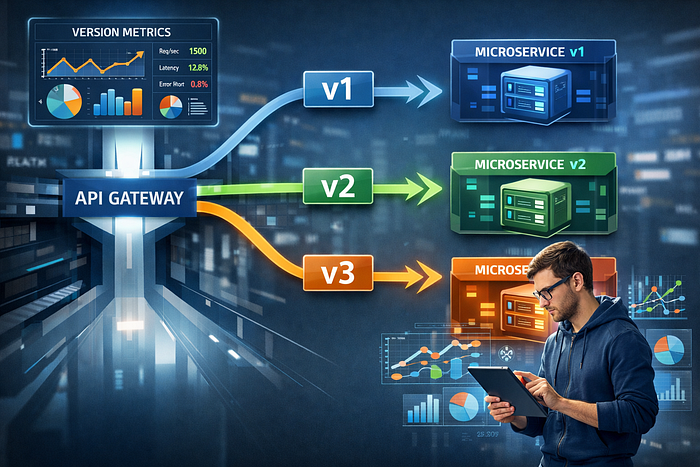
What is this, and why does it matter now?
In modern software ecosystems, APIs are product interfaces, not just technical contracts. They’re how your customers, partners, and internal teams interact with your logic and data. But here’s the catch: APIs evolve, and changes — even necessary ones — can break consumers.
Whether you’re running a public developer platform, a microservices architecture, or a mobile backend, versioning is your safety net. It’s the difference between rolling out improvements… and setting the internet on fire.
With the rise of contract-first development, multi-client deployments (mobile, web, IoT), and backward compatibility expectations, robust API versioning is not just hygiene — it’s survival.
Bob goes to the DMV
Imagine Bob has an old driver’s license issued by the DMV. One day, the DMV decides to modernize — issuing digital IDs instead of plastic cards.
But Bob’s license is still valid. He doesn’t have to switch until he’s ready. The DMV supports two ID systems in parallel, clearly labeled by version. Meanwhile, DMV staff know that Version 1 = plastic, Version 2 = digital. They route requests accordingly.
That’s API versioning in practice: letting the system evolve without invalidating Bob’s experience — while still encouraging migration over time.
Architecture or Flow Diagram (described in words)
Think of your API versioning architecture as a routing layer in front of your business logic. The key elements are:
Version-aware entry point (API Gateway or Router)
- Parses the incoming version (via URL path, header, or query param)
- Routes to the appropriate versioned controller/module
Versioned service handlers (V1, V2, etc.)
- Each implements business logic for its version
- May share core services or models internally
Deprecation manager (optional)
- Warns consumers of outdated versions
- Can include logging, metrics, or sunset headers
Documentation router
- Hosts separate or merged docs for each version
- Ensures developers understand differences
Some teams add a Version Adapter Layer to transform legacy payloads into the latest format — useful during migrations.
Code Examples With Full Explanation
Example 1: URL Path Versioning (Node.js / Express)
// app.js
const express = require('express');
const app = express();

const v1Routes = require('./routes/v1');
const v2Routes = require('./routes/v2');

app.use('/api/v1', v1Routes);
app.use('/api/v2', v2Routes);
This setup creates two clean namespaces. Your consumers can choose when to upgrade. Internally, you might share services:
// v2/controller.js
const orderService = require('../../services/orderService');

exports.getOrder = async (req, res) => {
  const order = await orderService.fetchEnhancedOrder(req.params.id);
  res.json(transformOrderToV2Format(order));
};
Example 2: Header Versioning (Spring Boot)
@GetMapping(value = "/order", headers = "API-Version=2")
public ResponseEntity<OrderV2> getOrderV2(@RequestParam Long id) {
    return ResponseEntity.ok(orderService.getOrderV2(id));
}
Clients call:
GET /order
API-Version: 2
Pros: Clean URLs.
Cons: Easy to forget headers. Not great for caching or documentation.
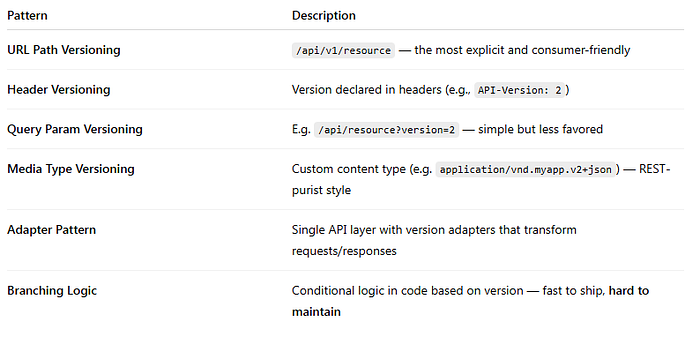
Implementation Patterns Breakdown
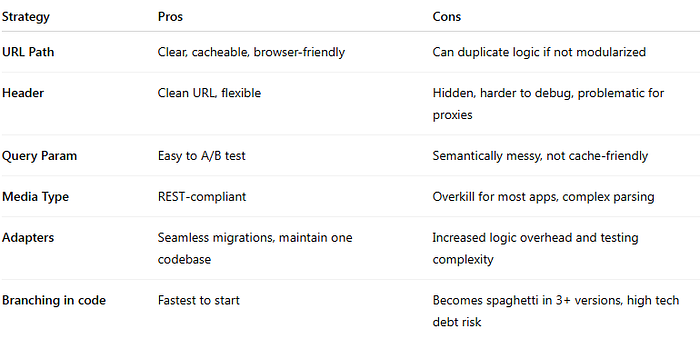
Pros and Cons of Each
Real-World Use Cases
- Stripe uses URL versioning + soft deprecation windows
- GitHub uses media type versioning for APIs (e.g.,
application/vnd.github.v3+json) - Twitter split versioned endpoints by function (
/1.1/,/2/) - Internal Microservices in enterprise systems often use adapter layers to maintain consistent backend interfaces
Risks, Trade-Offs, and Gotchas
- Version Drift — Old versions may remain active for years unless enforced by sunset policies
- Testing Explosion — Every version multiplies the number of test cases
- Zombie APIs — Forgotten versions can linger without monitoring
- Client Incompatibility — Some mobile/web clients don’t update quickly, slowing migrations
- Analytics Fragmentation — If your logs don’t tag versions clearly, it’s hard to analyze usage
Future Trends
- GraphQL + schema versioning with backward-compatible evolution
- OpenAPI-based changelogs for automated doc diffs
- AI-powered interface diffing to detect breaking changes
- Contract testing tools (like Pact) to enforce consumer expectations across versions
- Shadowing production traffic to new versions before going live
The direction is toward non-breaking evolution, adapter-powered compatibility, and contract-aware tooling that makes versioning feel safe not painful.
Find us
Balian’s Blogs Balian’s
linkedin Shant Khayalian
Facebook Balian’s
X-platform Balian’s
web Balian’s
Youtube Balian’s
#API #Versioning #Microservices #SoftwareArchitecture #DeveloperTools #Backend #OpenAPI #RESTful #DevOps #Scalability #APIManagement