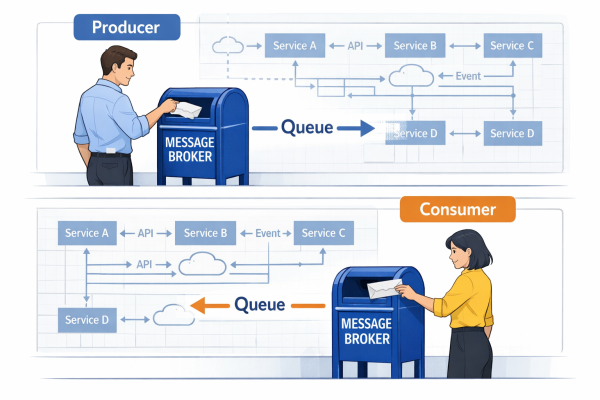

Asynchronous messaging in microservices diagram showing producer, message queue, and consumer

Why Your Microservices Are Fighting: The Case for Asynchronous Messaging

Views: 0 Asynchronous messaging is the communication pattern that lets distributed systems talk without waiting. In microservices, services often need to trigger actions in others, but doing that synchronously (e.g., REST calls) introduces coupling, latency, and cascading failures. Asynchronous messaging uses message brokers (like Kafka, RabbitMQ, NATS) to decouple services. The sender publishes a message and moves on; the receiver processes it when ready….

Read More
Secure-Peer-to-Peer-Apps

A2A Protocol: Deep Dive

Views: 0 In today’s increasingly decentralized world, applications need to communicate with each other directly — securely, efficiently, and without relying on centralized intermediaries. This is where the A2A protocol comes into play. A2A stands for App-to-App communication. It’s a protocol that enables one application (like a crypto wallet) to interact directly with another (like a decentralized app or service),…

Read More
Mojo programming language comparison with Python and C++

Exploring Mojo: The AI-Optimized Programming Language Bridging Python and C++

Views: 0What is Mojo? Mojo is a cutting-edge programming language developed by Modular Inc. It’s designed to offer the simplicity of Python with the performance and control of C++ and Rust, making it perfect for AI, ML, and systems-level development. Key Features: 2. Why Mojo Matters in AI AI systems require both scalability and performance. Python, although widely used, often underperforms…

Read More

My Top 10 Java Utility Functions You’ll Want to Steal

Views: 0Unlocking Java’s hidden gems with Bob’s everyday adventures. The Power of Utility Functions In Java development, utility functions are like the Swiss Army knives of coding — they provide reusable solutions to common problems, enhancing code readability and maintainability. Typically housed in utility classes (often with names ending in Utils), these static methods help avoid…

Read More

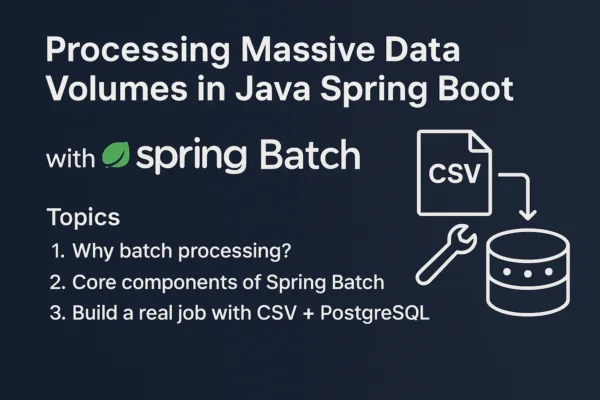
Processing Massive Data Volumes in Java Spring Boot (with Spring Batch)

Views: 0In modern enterprise systems, data doesn’t just arrive — it floods. When handling massive datasets, especially in back-end infrastructure, Spring Batch offers a rock-solid solution for processing jobs efficiently, safely, and at scale. What is Spring Batch? Spring Batch is a lightweight, scalable batch processing framework in the Spring ecosystem. It’s built to support…

Read More
Translate »